You’ve got a project coming up, and you’re pretty sure you need a machine that can lift heavy loads, reach heights, and handle ground that a standard forklift would struggle on. A telehandler keeps coming up. But before you commit to a hire, it’s worth confirming it’s genuinely the right tool for what you’re doing.
This guide covers the essentials: what a telehandler actually is, what it’s built to do, how it compares to a standard forklift, what licence your operator needs, what hire costs look like, and how to pick the right size machine for the job.
What Is a Telehandler?
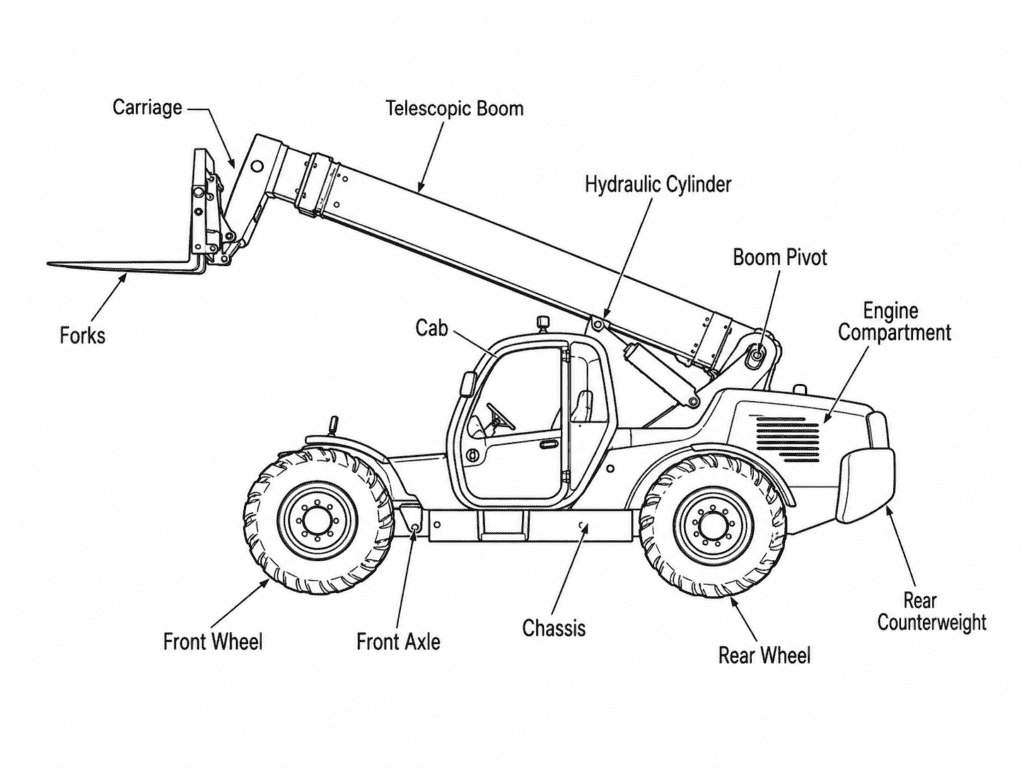
A telehandler, short for telescopic handler, is a rough-terrain lifting machine with an extendable boom arm mounted on an all-wheel-drive chassis. The boom telescopes forward and upward at an angle, which gives the machine a combination of lift height and horizontal reach that a standard forklift can’t match.
What makes a telehandler genuinely versatile is its quick-hitch attachment system. The same machine can run pallet forks, a crane jib, a work cage, a bucket, or a bale clamp, depending on the task. Swap the attachment, and you’ve effectively got a different machine, which is why a single telehandler on site can often replace two or three separate pieces of equipment.
You’ll also hear them called telescopic handlers, telehandlers, or just “telies.” They’re all the same machine.
What Is a Telehandler Used For?
On construction sites, telehandlers are primarily used for:
- Lifting palletised materials — bricks, blocks, bagged cement, tiles — to elevated floors or over obstacles
- Placing structural steel, roofing materials, or prefabricated sections at height
- Loading and unloading delivery trucks on unpaved or uneven ground
- Moving loads across rough terrain where a standard forklift can’t safely operate
- Lifting workers in a work cage for elevated access tasks
Outside of construction, telehandlers are widely used in agriculture for moving hay bales, handling feed, and working around farm sheds and yards. The same combination of rough-terrain capability and reach makes them well-suited to rural settings.
The key practical advantage of busy sites is consolidation. Rather than hiring a forklift for palletised goods, a crane for heavy lifts, and an elevated work platform for access tasks, a telehandler with the right attachments can cover all three. That has real cost implications when you’re managing a project budget.
Telehandler vs. Forklift
The honest answer is that it depends on the site and the task. A telehandler isn’t always the right call, and neither is a standard forklift.
A standard counterbalance forklift is the more economical choice if your site is flat and paved, your loads are palletised, and you don’t need to work above 5-6 metres. They’re simpler to operate, typically cheaper to hire, and well-suited to warehouse-style environments.
A telehandler is the better tool when:
- The ground is uneven, muddy, or unpaved, and a standard forklift would struggle with traction or stability
- You need to place materials at a significant height or over obstacles
- You need diagonal reach — picking up a load and placing it into a space that’s forward and upward simultaneously
- The site requires multiple lifting functions that would otherwise mean hiring more than one machine
If your project involves any combination of rough terrain, height, and varied tasks, a telehandler will almost always be the more practical and cost-effective option.
Do You Need a Licence to Operate a Telehandler?
Yes. In Australia, operating a telehandler requires a High Risk Work (HRW) licence. The relevant class is LF — Forklift Truck — which covers counterbalance forklifts, reach trucks, and telehandlers under the same licence category.
To obtain an LF licence, operators complete a training course through a registered training organisation (RTO), covering both theory and practical assessment. The licence is issued by the relevant state or territory regulator — in Queensland, that’s WorkSafe Queensland; in NSW, SafeWork NSW; and so on under the Safe Work Australia framework.
The licence is nationally recognised, so an operator licensed in one state can legally operate in another.
For project managers organising a telehandler hire: if you’re taking a wet hire (machine plus operator supplied by the hire company), the operator will hold the required licence as a matter of course. If you’re arranging a dry hire and supplying your own operator, you need to confirm that the person holds a current LF licence before the machine is delivered to the site.
How Much Does It Cost to Hire a Telehandler?
Hire costs vary depending on the machine’s size, the hire duration, and whether you’re arranging wet hire (machine plus operator) or dry hire (machine only). Delivery and collection to the site are typically charged separately.
As a general guide:
- Compact telehandlers (2–2.5-tonne capacity) suit tight sites, residential builds, and projects with restricted access. They carry a lower hire rate and are typically sufficient for most standard construction tasks.
- Larger machines (3.5–5 tonne, 14–17m lift height) are suited to larger commercial projects, multi-storey construction, or jobs where materials need to be placed at a significant height. These carry a higher hire rate reflecting their capacity and capability.
Day rates are the most expensive way to hire. Weekly and monthly rates bring the effective daily cost down considerably — if your project runs for more than a few days, a weekly or monthly hire almost always makes more financial sense.
When comparing hire quotes, check whether fuel is included, whether the rate covers all attachments you need, and what the call-out cost is if the machine requires servicing on-site. These variables can make a material difference to the total cost of a hire.
Freedom Forklifts can provide a hire quote matched to your specific project requirements. Contact the team to discuss machine size, duration, and operator arrangements.
Which Telehandler Is Right for Your Site?
The two most common questions are: how much does the machine need to lift, and how high does it need to reach? Those two answers will determine which model is appropriate.
Freedom Forklifts stocks the Dieci telehandler range, which covers both ends of the spectrum for construction use.
Dieci Apollo (2.5 tonne) — A compact, manoeuvrable machine suited to residential and smaller commercial builds. The reduced footprint makes it practical for tighter access conditions, and the 2.5t capacity comfortably handles most standard construction materials. If the site is constrained and the lift heights involved are within the standard range, this is typically the more cost-effective hire.
Dieci Icarus 40.17 (4 tonne, 17m lift height) — Built for larger commercial and civil construction projects. The 4t capacity and 17m maximum lift height make it the right machine for heavy loads or for placing them on upper floors or above significant obstacles. If you’re building above three storeys, placing precast elements, or working with loads at the heavier end of the spectrum, this is the model that handles it.
Not sure which model fits your project? The Freedom Forklifts team can walk through the specifics with you before you commit to a hire.
Ready to Hire a Telehandler?
If your project involves rough terrain, significant lift height, or tasks that would otherwise require more than one machine, a telehandler hire is likely the right call. Freedom Forklifts offers both dry hire and wet hire on telehandlers, with flexible rates.
Get in touch with the team to discuss your project requirements and get a hire quote.