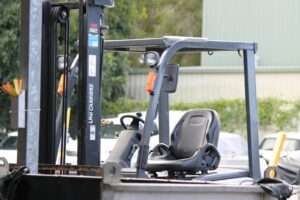
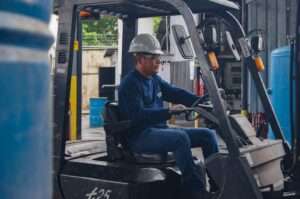
The data plate on your forklift is a small piece of metal, usually fixed to a stanchion near the operator’s seat, and most operators have glanced at it without ever reading it closely.
But it carries information that is fundamental to safe operation and legal compliance. It tells you exactly what the machine can lift, how high, how far, and under what conditions. Get any of that wrong, and you’re either operating unsafely or outside the law.
This article covers what a forklift data plate is, what every field on it means, where to find it on the machine, and what your obligations are if the plate is damaged or missing.
What Is a Forklift Data Plate?
A forklift data plate, also called a rating plate or capacity plate, is a metal plate affixed to every powered industrial truck that specifies the machine’s operating limits and key specifications as determined by the manufacturer.
In Australia, fitting a data plate is a requirement under Australian Standard AS 2359.2-2013, which covers powered industrial trucks.
The plate does two things. First, it provides operators with the reference information they need before and during operation — rated capacity, lift height, load centre, and more.
Second, it provides a compliance record that the machine has been manufactured to a known specification. A forklift without a legible data plate is non-compliant, and operating it is a breach of workplace health and safety obligations under both the relevant Australian Standard and state WHS legislation.
Where Is the Data Plate Located?
On most counterbalance forklifts, the data plate is mounted on the overhead guard stanchion or dashboard column, positioned so it’s within clear sightline of the operator’s seat. The intent is that the operator can read the plate without leaving the machine. On some models, particularly older or non-standard units, it may be located on the mast or cowl instead.
If the plate isn’t immediately visible, check the operator’s manual for the manufacturer’s specified location for that model. It should not require searching — if it does, that’s worth flagging during your next service inspection.
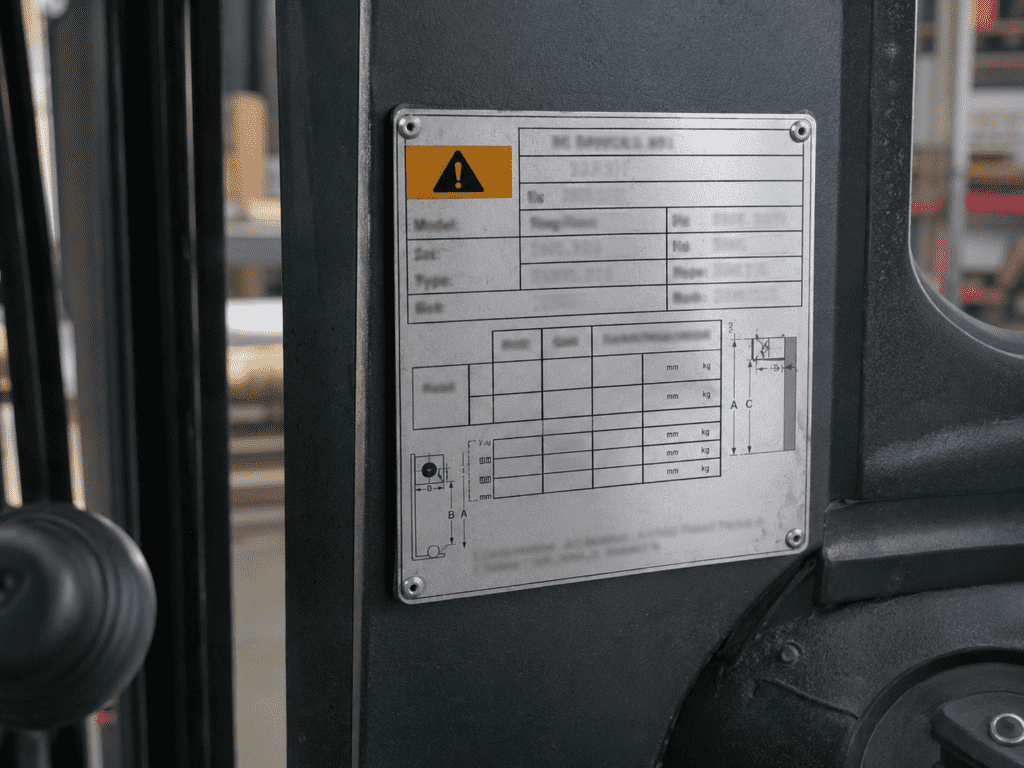
An example of a forklift data plate mounted on a counterbalance forklift dashboard column.
How to Read a Forklift Data Plate
Data plates vary in layout between manufacturers, but the information they contain is consistent. Here’s what each section covers.
Identity Fields: Model and Serial Number
The model number identifies the machine type and is the reference point for sourcing parts, accessing service documentation, and communicating with the manufacturer or dealer. The serial number is unique to that individual unit — it’s the more precise identifier, and the one a technician or parts interpreter will ask for first. The serial number pulls up the specific build record for that machine, including its exact configuration and any known issues for that production run.
Both numbers should also be recorded somewhere off the machine — in your service records or asset register — so they remain accessible if the data plate is ever damaged.
Machine Specifications
This section of the plate covers the machine’s core physical and mechanical characteristics.
- Year of manufacture — relevant for parts procurement and understanding the machine’s history, particularly for used equipment.
- Fuel or power type — diesel, LPG, petrol, or electric. This affects site safety planning (ventilation requirements for internal combustion engines), refuelling arrangements, and the machine’s suitability for indoor use.
- Nominal power — the average power output of the machine in kilowatts.
- Truck weight (unladen) — the weight of the machine without any load on the forks. This is important when assessing whether a floor, ramp, or surface is rated to take the machine. Note that a loaded forklift will be considerably heavier — the surface rating needs to account for both the machine weight and the maximum load.
- Tyre specifications — the size and type of tyre the machine was built to run on, whether cushion, pneumatic, or solid. Always replace like for like — changing tyre type affects stability and rated capacity.
Mast and Tilt Specifications
The plate shows the maximum forward and backward tilt of the mast in degrees. These are structural limits set by the manufacturer — not guidelines. Operating the mast outside these angles poses tip risk, particularly when a load is on the forks. The forward tilt figure is also directly relevant to the load table, which specifies reduced capacity when the mast is tilted forward.
The Load Table — The Most Important Section
The load table occupies the lower portion of most data plates and is the information operators should consult before every lift. It’s also the section most commonly misread or ignored, and misreading it is a primary cause of forklift tip-overs and structural failures on Australian worksites.
The load table specifies:
- Rated capacity — the maximum load the machine can safely lift, expressed in kilograms. This is not a fixed number across all conditions. It changes with load centre distance and mast position.
- Load centre — the horizontal distance from the face of the forks to the centre of gravity of the load. For most counterbalance forklifts in Australia, the standard load centre is 500mm. A load with a greater depth — or one positioned further back on the forks — shifts the effective load centre outward, reducing the machine’s safe lifting capacity. A 2,500 kg-rated machine at a 500mm load centre may only be safely rated for 2,000 kg or less at a 600mm load centre.
- Maximum lift height — the maximum height the mast can extend under load.
- Capacity with mast vertical vs. mast tilted forward — rated capacity is higher when the mast is vertical and lower when tilted forward. Operators lifting near maximum capacity should always confirm which mast position applies to their lift.
The practical implication of the load table is that rated capacity is context-dependent. A load that sits within rated capacity under one set of conditions may exceed it under another. Operators need to understand the relationship between load centre, lift height, and mast position.
Attachments
Any attachments fitted to the machine, such as side-shifter, fork positioner, clamp, or jib, are listed on the data plate because they affect rated capacity. An attachment adds weight to the front of the machine, shifting the load centre and reducing the load the machine can safely carry. If an attachment is fitted that isn’t listed on the original data plate, the plate is effectively no longer accurate, and the machine should be re-rated by the manufacturer or an authorised assessor.
What to Do If the Data Plate Is Missing or Damaged
This is not a situation where you can make a judgment call about whether the machine is probably fine to keep running. Under Australian WHS legislation and AS 2359.2-2013, a forklift must not be operated if the data plate is missing, illegible, or has been altered. The machine needs to come out of service until the plate is replaced.
The steps are straightforward:
- Take the machine out of service immediately and tag it out of operation.
- Locate the machine’s model and serial number. These should be recorded in your service or asset documentation even if the plate is gone — this is one of several reasons to maintain those records.
- Contact the original equipment manufacturer or an authorised dealer to arrange a replacement plate. The replacement must be an OEM plate — handwritten substitutes or aftermarket alternatives do not satisfy the compliance requirement.
- Return the machine to service only once the replacement plate is fitted and clearly legible.
It’s also worth acting proactively on plates that are worn, faded, or partially obscured — don’t wait until a plate is completely unreadable. If an inspector determines a plate isn’t clearly legible, the machine will be stood down regardless of how well the operator knows the specs from memory.
Freedom Forklifts can assist with data plate replacement enquiries for forklifts in their hire and sales fleet. Contact the team with the machine’s model and serial number.
Why the Data Plate Matters Beyond Compliance
Compliance is reason enough to take the data plate seriously. But the more practical argument is that the load table is the fastest and most reliable on-site reference point for confirming whether a specific lift is safe. Operators who understand what they’re looking at — particularly the load centre relationship — are less likely to attempt lifts that exceed the machine’s actual capacity under the conditions they’re working in.
A significant proportion of forklift incidents in Australia involve overloading or improper load positioning. Both are preventable with a correct reading of the data plate. Making the data plate part of every pre-start check — not just something operators glance at during induction and never look at again — is a simple, low-cost safety improvement for any operation that runs forklifts.
Need Help With Your Forklift?
Whether you need a data plate replacement, a service inspection, or advice on the right machine for your operation, the Freedom Forklifts team can help. Get in touch to discuss your requirements.