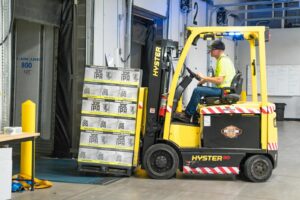
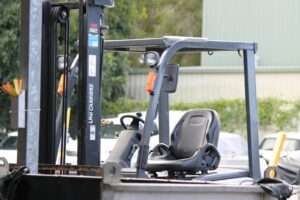
Pallet jacks, walkie stackers, and order pickers work in the same aisles and are often lumped together or mistaken for forklifts. Each one does a different job. A pallet jack moves pallets along the floor, a walkie stacker lifts them into racking, and an order picker lifts the operator up to pick individual items by hand.
Below we cover what each machine does, how they compare on lift height and capacity, which ones need a high-risk work licence in Queensland, and how to match one to your site.
The Short Answer
- Pallet jack: moves whole pallets along the floor. It raises the load just enough to clear the ground, so it stays at floor level.
- Walkie stacker: lifts whole pallets into low- to mid-level racking while the operator walks behind it. Walk-behind models sit outside the forklift licence definition.
- Order picker: lifts the operator on a platform so they can pick individual cartons or items from height. Operators need an LO licence.
If you’d like a second opinion on your site, call our Nerang team on 07 5596 5777 with your heaviest load, your top racking height and your narrowest aisle.
What Is A Pallet Jack?
A pallet jack, also called a pallet truck, slides its forks under a pallet, raises it a few centimetres and moves it horizontally. You’ll find them on loading docks, in dispatch areas and on short runs between receiving and storage.
There are two types:
- Manual pallet jacks. The operator pumps the handle to raise the forks hydraulically, then pushes or pulls the load. They suit occasional moves over short distances.
- Electric pallet jacks. A battery-powered motor drives the machine and raises the forks, while the operator walks alongside and steers with the tiller. They suit sites that move pallets all day or over longer runs, and they take the push-and-pull strain off your team.
The EP EPL154 electric pallet jack is a good example of a compact unit in our range. It carries 1.5 tonnes, has a 400 mm chassis width and a 1,330 mm turning radius, and runs on a 24V lithium-ion battery that charges in about three hours.
A pallet jack works only at floor level. Once stock needs to go up into racking, the job moves to a stacker or a forklift.
What is a Walkie Stacker?
A walkie stacker, also sold as a pallet stacker, adds a mast to a pallet-truck base so it can lift pallets into racking. The operator walks behind and controls travel, lifting and lowering from the tiller head. Some models add a fold-down platform so the operator can ride, which changes the licence position (more on that below).
Walkie stackers come in three main designs:
- Straddle stackers have base legs that sit either side of the pallet. They’re stable and simple, but the legs need clear space either side, so check them against your pallet sizes and racking layout.
- Walkie reach stackers move the forks forward into the racking, so the base legs stay clear of the rack. The EP CQE15S walkie reach stacker in our range lifts 1.5 tonnes to 5.5 metres on a three-stage mast.
- Counterbalance stackers use a rear counterweight in place of front legs. That lets them handle pallets that base legs can’t straddle.
Walkie stackers suit smaller warehouses, back-of-house storage, and staging areas, especially where aisles are too tight for a counterbalance forklift to turn. They work best on flat, smooth concrete, and their capacity reduces as the mast extends, so check the load chart for your heaviest pallet at your top beam height.
What is an Order Picker?
On an order picker, also called a stock picker, the operator stands on a guarded platform that rises with the controls. The operator drives to the location, rises to the shelf and picks cartons or items straight into a tray or onto a pallet, so there’s no need to bring a full pallet down to take two boxes off it.
The EP JX0-30 electric order picker in our range is a compact model built for this kind of work. It has a 3 metre platform height and a 4.6 metre picking height, carries 220 kg in total (130 kg for the operator plus 90 kg in the tray), and runs on a 24V lithium-ion battery. Larger order pickers lift higher and can carry a full pallet.
Order pickers are common in e-commerce fulfilment, parts and spares stores, and retail distribution, where staff pick high volumes of individual items from shelving above head height. They also reduce ladder work at height.
Side-By-Side Comparison
| Pallet jack | Walkie stacker | Order picker | |
|---|---|---|---|
| Main job | Moving pallets along the floor | Lifting pallets into racking | Picking cartons and items at height |
| What it lifts | Whole pallets | Whole pallets | The operator plus picked items |
| Working height | Floor level | Low to mid-level racking | Shelving above head height |
| Example from our range | EP EPL154: 1.5 t, 1,330 mm turning radius | EP CQE15S: 1.5 t to 5.5 m | EP JX0-30: 220 kg total, 4.6 m picking height |
| Operator position | Walks with the machine | Walks behind (ride-on models available) | Rises on the platform with the controls |
| Power | Manual hydraulic or electric | Electric | Electric |
| Licence in Queensland | No high risk work licence | No high risk work licence for walk-behind models | LO licence |
| Best suited to | Docks, loading trucks, short runs | Small warehouses, tight aisles, low to mid racking | E-commerce, spare parts, carton picking |
Aisle width depends on the model, the stacker design and your pallet size. Each manufacturer datasheet lists the aisle width needed for a standard pallet, and we can check it against your floor plan.
Do You Need a Licence?
In Queensland, the Work Health and Safety Regulation 2011 defines a forklift truck as a powered industrial truck with a mast and an elevating load carriage, fitted with forks or arms that can be raised 900 mm or more. The definition excludes pedestrian-operated trucks and pallet trucks. WorkSafe Queensland sets out which licence class applies to each machine.
- Pallet jacks (manual and electric): no high risk work licence required.
- Walk-behind walkie stackers: no high risk work licence required, as pedestrian-operated trucks sit outside the forklift truck definition.
- Ride-on stackers: once the operator rides on the machine, it’s no longer pedestrian-operated. Check the model against the WorkSafe Queensland definition before anyone operates it without a licence.
- Order pickers: an LO licence is required. The LF forklift licence covers forklift trucks but excludes order-picking forklift trucks.
Training duties apply to every machine, licensed or not. WorkSafe Queensland’s guidance on when you don’t need a licence notes that employers still need to give operators the information, training, instruction and supervision to use plant safely.
Which One Suits Your Operation?
Unloading trucks and staging pallets on the floor. If pallets come off a truck and sit on the floor until dispatch, an electric pallet jack is a good fit. You save the cost of a mast you won’t use, and your team avoids the strain of pulling loaded pallets across a long floor.
Racking to around 4 to 5 metres with tight aisles. A walkie reach stacker places pallets into the racking without the turning space a counterbalance forklift needs, and walk-behind models need no high-risk work licence. It suits indoor sites with a flat, level slab.
Picking cartons from high shelving. If your team picks individual items from shelves above head height, an order picker lifts them to the shelf on a guarded platform and replaces ladder work. Allow for LO licensing in your plan.
Heavy pallets, high racking and long shifts. Stacking heavy pallets above 5.5 metres, or moving between the yard and the warehouse, calls for a forklift. A counterbalance forklift handles yard work and truck loading, and a high reach forklift handles tall indoor racking. Our guide to common forklift types in Australian warehouses compares the options.
Hire Or Buy?
Hire suits seasonal peaks, short-term contracts and trialling a machine or aisle layout before you commit. We maintain the machine, and you can step up or down as volumes change. See our equipment hire options.
Buying or leasing suits a machine that runs every day as part of your core operation. Browse our new equipment, or ask about forklift leasing.
Talk To The Freedom Forklifts Team
The right machine comes down to three numbers: your heaviest load, your top racking height and your narrowest aisle. Call us with those, and we’ll recommend a pallet jack, stacker or order picker to hire or buy, along with any attachments you need.
Call our Nerang team on 07 5596 5777 or our Yatala team on 07 3059 5040, or get in touch online.
Frequently Asked Questions
Is a walkie stacker a forklift?
A walkie stacker has a mast and lifts pallets like a forklift, but walk-behind models sit outside the forklift truck definition in the WHS Regulation. Operators can use one without an LF licence, but they still need training to use it safely.
How high can a walkie stacker lift?
It depends on the model and the mast. The EP CQE15S in our range lifts 1.5 tonnes to 5.5 metres on a three-stage mast. Capacity reduces as the forks rise, so check the load chart against your heaviest pallet and top beam height.
What is the difference between a forklift and an order picker?
A forklift lifts the load while the operator stays on the ground. An order picker lifts the operator with the controls so they can pick by hand at the shelf. Forklifts need an LF licence, and order pickers need an LO licence.
Can two people ride on an order picker?
No. Order pickers are designed for one operator, and the platform’s rated capacity covers one person plus the tray load. On the EP JX0-30, that’s 130 kg for the operator and 90 kg in the tray.