Brand loyalty in the forklift industry runs deep, and for good reason. When a forklift goes down unexpectedly, productivity slows, deadlines slip, labour costs rise, and safety risks can increase.
But “most reliable” doesn’t simply mean the forklift least likely to break down.
For Australian businesses, reliability usually means:
- Consistent uptime under real workloads
- Fast access to parts and technicians
- Long engine or battery lifespan
- Strong resale value
- Good operator feedback over long shifts
- Performance in your environment (warehouse, yard, construction site, cold storage, etc.)
A machine that performs brilliantly in a clean warehouse may not suit a dusty yard. Likewise, a cheaper forklift may look attractive up front, but costs more over five years due to repairs and downtime.
Having sold, hired and serviced forklifts across Australia, here is a practical look at the brands that repeatedly earn trust in the market.
What Makes A Forklift Brand Reliable?
Before comparing brands, it’s worth agreeing on what reliability means in the context of forklifts. There are four factors that matter:
- Uptime: How often does it break down, and how serious is it when it does? This is the one most people think of first, but it’s only part of the picture.
- Parts availability: When something does need attention, how quickly can you get the parts in Australia? A brand with great build quality but a slow or expensive supply chain creates its own problems.
- Service support: Is there a qualified technician in your area who can work on it? Some brands have dense dealer networks. Others are patchier outside major metros.
- Resale value: This matters if there’s any chance you’ll want to sell the machine. A forklift that holds its value gives you more options later.
The brands that score well across all four tend to be the ones that come up again and again when you ask experienced operators which machine they’d put their money on.
1. Toyota Forklifts
Toyota is one of the safest “default” recommendations in the Australian forklift market because it performs well across the main reliability factors:
- Build quality
- Parts support
- Service availability
- Resale value
- Operator familiarity
Toyota Material Handling Australia positions its forklifts around quality, durability, and reliability, with more than 50 years of demonstrated local market presence.
One of Toyota’s major strengths is its System of Active Stability, commonly known as SAS, a patented safety system that monitors forklift operation and automatically responds when it detects conditions that could lead to truck or load instability. This is especially valuable in busy warehouses, loading areas and mixed-skill workplaces where stability, cornering and load control can directly affect safety and uptime.
Toyota is a strong fit for high-utilisation businesses that need a forklift to work every day without becoming a maintenance burden.
The trade-off is that Toyota usually sits in the premium price tier, both for the machine itself and genuine parts. For lighter-use sites, that premium may not always be necessary. But for businesses where downtime is costly, Toyota’s higher upfront cost is often easier to justify over the machine’s full life.
2. Crown Forklifts
Crown is particularly strong in warehouse environments, especially where operator comfort, manoeuvrability and productivity matter as much as raw lifting capacity. Its Australian forklift range covers electric pallet jacks, rider pallet trucks, stackers, reach trucks, order pickers, tow tractors and internal combustion forklifts, but the brand is especially well known for electric warehouse equipment.
For reach trucks, Crown highlights lift height, capacity, visibility and energy efficiency as key strengths. That makes Crown a practical option for distribution centres, cold storage, narrow-aisle facilities, and warehouses where operators work in tight spaces for long shifts.
Crown’s ergonomics are worth calling out because reliability is not only mechanical. A machine that is easier to see from, easier to control and less fatiguing to operate can improve productivity and reduce operator error. Crown’s ESR reach truck range, for example, includes visibility-focused features such as an offset mast and optional panoramic glass, as well as intelligent speed reduction in turns and OnTrac anti-slip traction control for wet, dusty or freezer applications.
Crown may not always be the first choice for heavy outdoor use, but in clean warehouse environments, it has a strong argument. If a business needs reach trucks, order pickers or electric equipment for frequent use across racking aisles, Crown deserves serious consideration.
3. Hyster Forklifts
Hyster has a long-standing reputation for tough, industrial forklifts. It is a particularly strong brand to discuss when reliability means surviving demanding conditions rather than simply running quietly in a warehouse. Hyster says its forklifts and container-handling equipment are built for demanding environments, including industrial warehouses, manufacturing facilities, ports, terminals, timber mills, and mining sites.
This makes Hyster a natural fit for outdoor operations, freight yards, heavy manufacturing, building supplies, timber handling and high-capacity lifting. Its heavy-duty forklift range includes pneumatic-tyre models with load capacities from 8,500 kg to 48,000 kg, depending on the model family.
The key benefit of Hyster is durability under pressure. These forklifts are often chosen for sites where machines are exposed to uneven ground, heavier loads, long operating hours or less forgiving environments. They may not always feel as refined as some premium warehouse-focused brands, but that is not usually the reason buyers choose Hyster. They choose it because they need something robust.
4. Caterpillar (CAT) Forklifts
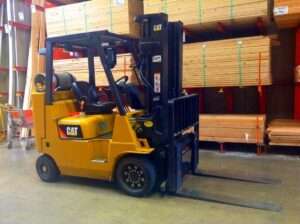
CAT Forklifts benefit from one of the strongest names in heavy equipment. For many buyers, the CAT badge signals durability, construction-site toughness and long-term confidence. Cat Lift Trucks positions its range around robust, efficient, and performance-enhancing forklift trucks and warehouse equipment, backed by more than 80 years of materials handling experience.
CAT forklifts are especially relevant for businesses working across yards, logistics depots, construction supply, manufacturing, building materials and mixed indoor-outdoor applications. The brand has a strong fit for operators who want a forklift that feels practical, familiar, and built for harder use.
CAT forklifts are part of the Mitsubishi Logisnext manufacturing ecosystem, a comprehensive logistics equipment manufacturer focused on logistics, automation, safety and decarbonisation. This gives CAT forklifts a useful engineering context beyond the badge itself.
CAT is a good option when buyers want a recognisable heavy-equipment brand, strong support, confidence and a forklift suited to demanding work. It may not always be the cheapest choice, but it appeals to businesses that already trust CAT equipment in other parts of their fleet.
5. Royal Forklifts
Royal sits in a different part of the market from Toyota, Crown or CAT. It is more value-driven, making it relevant to businesses that need dependable lifting equipment without paying a premium brand price. Royal’s own product range includes internal combustion forklifts, electric forklifts, rough terrain forklifts, warehousing equipment and scissor lifts.
Some often refer to Royal Forklifts as the ‘BYD of forklifts’. It is a new brand on the market with state-of-the-art technology, strong resale value, and innovative designs.
For Freedom Forklifts, we love working with Royal because it offers buyers an alternative between older, second-hand premium machines and expensive new premium models. Royal’s range can easily meet the needs of a practical forklift for general warehousing, manufacturing, stock handling or supplementary fleet capacity.
The Pro Plus lithium forklift range is especially worth mentioning. Royal describes its 4,000 kg to 5,000 kg Pro Plus lithium battery forklifts as using a diesel-chassis design with a 153.6V full AC system, zero emissions, and high IP protection for key components.
The key buyer caveat is support. Parts, servicing and warranty support are strong locally, making Royal a very practical option.
So Which Forklift Brand Is Right For Your Operation?
There isn’t one universal “best” forklift brand, and any supplier who claims there is before understanding your site, workload, and budget is oversimplifying the decision.
The better question is: which forklift brand is best for the way you actually operate?
The right machine depends on factors like:
- How many hours will it run each day
- Whether it works indoors, outdoors or both
- Load weights and lift heights
- Fuel preference: electric, LPG, diesel or lithium
- Aisle widths and turning space
- Your tolerance for downtime
- Local parts and service support
- Whether resale value matters later
If your forklift is critical to day-to-day output and runs hard most days, reliability and fast support usually outweigh upfront price.
Best fit: Toyota or Hyster
If your forklift spends most of its life inside, manoeuvrability, visibility and operator comfort become more important.
Best fit: Crown or Toyota Electric
If your forklift works on harder surfaces, variable weather or less forgiving sites, you want durability and stability.
Best fit: Hyster, CAT or Dieci
If the machine won’t run full-time, or you need to maximise budget without compromising practicality, value brands deserve consideration.
Best fit: Royal, EP Equipment or Yale
If fuel costs, emissions, charging convenience, or lower maintenance are priorities, electric forklifts are worth serious attention.
Best fit: EP Equipment, Crown, Toyota or Royal Lithium range
If you are entering the market through second-hand equipment, brand reputation and service history matter even more.
Best fit: Toyota, Crown, Hyster or CAT
Still unsure? Start with hiring.
If you’re uncertain, hiring first can be the smartest move. It lets you test:
- suitability for your site
- operator feedback
- battery or fuel performance
- visibility and comfort
- real-world productivity
The best forklift brand for your business is the one that keeps working in your conditions, with parts you can source and support you can rely on.
That matters just as much as the badge on the side.
Freedom Forklifts stocks and services Toyota, Crown, Hyster, CAT, Royal, EP Equipment, Yale and Dieci across QLD, NSW and VIC. Our team works with these machines daily across sales, hire and servicing, so we can recommend what genuinely fits your operation, not just what sounds good in a brochure.
Check out available new and used material handling equipment online.