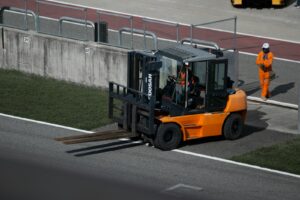
A counterbalance forklift is one of the most common styles of forklift used in material handling operations worldwide. What makes it different from other types is its simple, balanced design: a heavy weight at the back of the truck offsets the load’s weight at the front, keeping the machine stable when lifting and moving loads.
This design means there’s no need for outriggers or extending arms, making counterbalance forklifts easy to drive and manoeuvre in open areas such as warehouses, distribution centres and loading docks.
It is a versatile forklift type, and this guide breaks down exactly how it works, where it is used, and the considerations you need to make before purchasing or renting one for your next project.
How Does a Counterbalance Forklift Work?
At its core, a counterbalance forklift operates on a combination of basic physics, hydraulic power, and controlled operator input. The design allows the machine to lift heavy loads safely while remaining stable on flat ground.
The counterweight is mounted at the rear of the truck. This is a large, fixed mass, often made of cast iron, that offsets the load’s weight at the front. When a load is picked up:
- The weight of the load pulls the forklift forward.
- The counterweight pulls backward.
- The forklift’s wheels and chassis act as the pivot point between these two forces.
As long as the load stays within the forklift’s rated capacity, the combined weight distribution keeps the truck stable and prevents it from tipping forward.
Counterbalance forklifts also rely on a hydraulic system to raise, lower, and tilt loads. Hydraulic fluid is pressurised and directed into cylinders that power mast movement with precise control.
And finally, the operator controls the forklift through a combination of steering, drive pedals, and hydraulic levers. These controls allow the driver to make constant, small adjustments to keep the load stable.

Anatomy of a Caterpillar Counterbalance Forklift
Key Components of a Counterbalance Forklift
While forklifts come in many configurations, the core components are consistent across most counterbalance units:
Mast
The mast is the vertical rail system at the front of the forklift that raises, lowers, and stabilises loads. It houses the hydraulic cylinders and chains responsible for vertical movement.
Common mast types include:
- Single-stage masts: Limited lift height, often used outdoors.
- Two-stage (duplex) masts: Moderate lift height with better forward visibility.
- Three-stage (triplex) masts: Higher lift capability while maintaining a low collapsed height for indoor use.
Forks (Tynes)
The forks, also called tynes, are the arms that slide underneath pallets and loads. They attach to the carriage at the front of the mast and can be adjusted to suit different load widths.
Counterweight
The counterweight is a heavy mass mounted at the rear of the forklift. Its purpose is to balance the load’s weight at the front.
Tyres
Tyres play a major role in how a counterbalance forklift performs. Common tyre types include:
- Solid (cushion) tyres: Best for smooth indoor floors; low maintenance.
- Pneumatic tyres: Air-filled, suitable for uneven or outdoor surfaces.
- Non-marking tyres: Designed for environments where floor marking must be avoided.
Power Source (Electric, LPG, Diesel)
Counterbalance forklifts are powered by one of three main sources:
- Electric: Battery-powered, quiet, and emission-free, ideal for indoor warehouses.
- LPG: Versatile and quick to refuel; suitable for mixed indoor and outdoor use.
- Diesel: Powerful and robust, best suited to outdoor or heavy-duty applications.
The power source affects running costs, maintenance requirements, and where the forklift can safely operate.
Optional Attachments
Many counterbalance forklifts can be fitted with attachments to suit specific tasks, including:
- Side shifters
- Fork positioners
- Clamps for cartons, drums, or bales
- Load backrests
Types of Counterbalance Forklifts
Counterbalance forklifts are available in several power configurations, each designed to perform best in specific environments and workloads. While the fundamental design of a counterbalance forklift remains the same, the power source, tyres, and operating conditions significantly influence where and how the machine should be used.
Electric Counterbalance Forklifts
Best for indoor, controlled environments
Electric counterbalance forklifts are powered by large rechargeable batteries and are widely used in warehouses, distribution centres, and manufacturing facilities.
Key characteristics:
- Zero emissions, making them ideal for indoor use
- Quiet operation, suitable for shared or enclosed spaces
- Smooth acceleration and precise control
- Lower ongoing running costs due to reduced fuel and maintenance requirements
Because electric forklifts do not produce exhaust fumes, they are commonly used in:
- Warehouses and distribution centres
- Food and beverage facilities
- Manufacturing plants
- Retail back-of-house areas
They are particularly well-suited to businesses with predictable operating hours and access to charging infrastructure for batteries. Here’s a YouTube video exploring how to operate an electric counterbalance forklift:
LPG / Propane Counterbalance Forklifts
Versatile for mixed indoor and outdoor use
LPG (liquefied petroleum gas) counterbalance forklifts offer a balance between performance and flexibility. They use replaceable gas bottles, allowing for fast refuelling with minimal downtime.
Key characteristics:
- Strong and consistent power output
- Quick refuelling compared to battery charging
- Suitable for indoor use with adequate ventilation
- Performs well across varying workloads
LPG forklifts are commonly found in:
- Warehouses with loading docks
- Transport and logistics depots
- Manufacturing facilities with indoor and outdoor operations
- Distribution centres handling frequent truck loading and unloading
Standard 15-18kg LPG forklift tanks can last up to a full shift (8+ hours) depending on operational usage, but tank changeover is relatively quick, easy and doesn’t require hours of downtime. Most suppliers recommend keeping at least one spare tank for each LPG forklift on-site to avoid downtime. Here’s a short video on how to safely change a propane tank, so you can see how quick and easy it is:
Diesel Counterbalance Forklifts
Designed for heavy-duty outdoor applications
Diesel counterbalance forklifts are built for strength, durability, and outdoor performance. They are typically paired with pneumatic tyres to handle uneven ground and demanding conditions.
Key characteristics:
- High torque and lifting power
- Reliable performance over long shifts
- Suited to rougher surfaces and outdoor yards
- Produces exhaust emissions, limiting indoor use
Diesel forklifts are most commonly used in:
- Construction sites
- Timber yards and building supply centres
- Outdoor storage yards
- Ports and heavy industrial facilities
Diesel forklifts require refuelling like a car or truck, which results in typical downtime of 5-10 minutes. Storing forklift fuel on site is common in warehouses, yards, and construction environments, but it must be done in line with Australian safety, environmental, and workplace regulations.
Counterbalance Forklifts vs Other Forklift Types
| Feature | Counterbalance Forklift | Reach Truck | Pallet Jack | Telehandler |
| Primary function | General lifting and pallet handling | High-level storage in narrow aisles | Short-distance pallet movement | Heavy lifting on uneven terrain |
| Typical environment | Warehouses, yards, loading docks | Indoor warehouses only | Warehouses, retail back-of-house | Construction sites, farms |
| Lift height | Moderate | Very high | Very low | High (with forward reach) |
| Aisle width required | Medium to wide | Narrow | Narrow | Wide |
| Indoor use | Yes | Yes | Yes | Limited |
| Outdoor use | Yes (with suitable tyres) | No | Limited | Yes |
| Terrain capability | Flat surfaces | Flat indoor floors | Flat surfaces | Uneven/rough terrain |
| Load handling precision | High | Very high | Low | Moderate |
| Operator skill required | Low to moderate | Moderate to high | Low | Moderate |
| Versatility | High | Medium | Low | Medium |
| Typical industries | Warehousing, logistics, manufacturing | High-density warehousing | Retail, light logistics | Construction, agriculture |
| Cost (relative) | Medium | Medium to high | Low | High |
| Best suited for | All-purpose material handling | Maximising vertical storage | Basic pallet transport | Outdoor heavy-duty lifting |
A counterbalance forklift is usually the best option if your business:
- Handles palletised goods on flat surfaces
- Requires flexibility across multiple tasks
- Operates in open warehouse or yard environments
- Wants straightforward operation and maintenance
- Is purchasing its first forklift or expanding a general-purpose fleet
In many cases, businesses start with counterbalance forklifts and later add specialised equipment as operational demands evolve.
Safety and Training
Operating a counterbalance forklift safely requires formal training, ongoing awareness, and disciplined daily checks. While counterbalance forklifts are known for their straightforward design, most incidents occur not because the equipment is complex, but because fundamental safety principles are overlooked.
Balance and Load Stability
A counterbalance forklift relies on correct weight distribution to remain stable. Operators must understand how stability changes across different weight-distribution scenarios, such as raising loads, turning with elevated loads, and sudden braking or sharp turns.
Loads should always be positioned evenly on the forks, kept as low as possible during travel, and within the forklift’s rated load capacity.
Operator Training and Licensing
Anyone operating a forklift in Australia must hold a High Risk Work (HRW) Licence – Forklift Truck (LF), or be under direct supervision while formally training to obtain one.
This licence is issued by the relevant state or territory regulator and confirms that the operator has:
- Completed accredited forklift training
- Demonstrated practical competency
- Passed both theory and practical assessments
Operators are also required to receive site-specific training to understand their actual environmental conditions and relevant WHS guidelines.
If work conditions change or incidents occur, employers are required to provide refresher training and regularly review operator competency.
Pre-Operational Checks
Before operating a counterbalance forklift, operators should perform a pre-use inspection. These checks help identify faults early and prevent breakdowns or safety issues during operation.
Typical pre-use checks include:
- Fork condition (cracks, bends, wear)
- Mast and hydraulic function
- Tyres and wheels
- Brakes, steering, and controls
- Fuel levels or battery charge
- Warning lights and alarms
Any issues identified should be reported and resolved before the forklift is put into service.
Here’s a great YouTube video showcasing a pre-operational check:
Shopping For A Counterbalance Forklift?
Counterbalance forklifts form the backbone of most material-handling fleets due to their simple design, reliability, and versatility. Their ability to safely lift, transport, and place palletised loads makes them the most widely used forklift type across warehouses, manufacturing facilities, logistics hubs, and outdoor yards.
Whether you are buying or hiring, having a clear understanding of how counterbalance forklifts operate, the differences between electric, LPG, and diesel models, and the environments they are best suited to will help you make a more informed and cost-effective decision. Equally important is ensuring operators are properly trained and that safety procedures are followed consistently to protect people, equipment, and productivity.
At Freedom Forklifts, we supply new and used counterbalance forklifts for sale and hire, with options to suit a wide range of industries and applications. Our experienced team can take the time to understand your warehouse layout, site conditions, and project requirements to help you select the right equipment for your needs.
If you’re considering a counterbalance forklift, speak with the Freedom Forklifts team for practical advice and tailored solutions.