Modern storage systems are built to maximise height, which allows more stock to be stored in the same footprint. But this also means standard forklifts often can’t reach or manoeuvre safely in these taller, narrower spaces.
High reach forklifts are specialised machines designed for precision handling at height, allowing operators to lift heavy pallets several metres into the air while maintaining stability and control in confined aisles.
Curious to know if your operation requires a high reach forklift? Let’s explore what this equipment is capable of and everything that you need to know to get it operational.
So, What Is a High Reach Forklift?
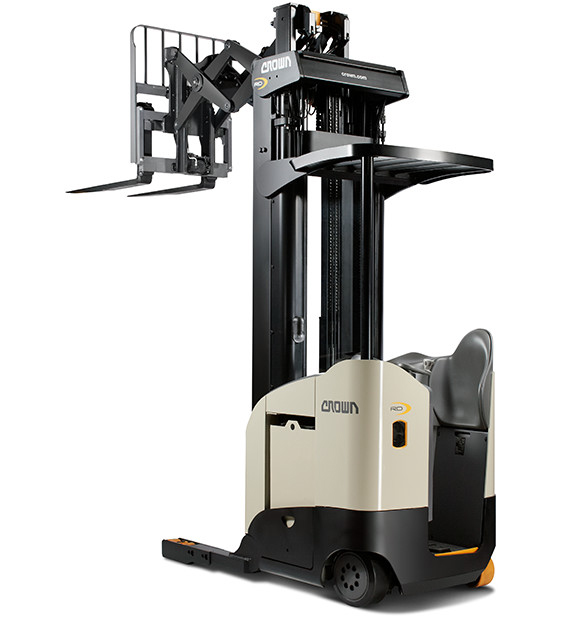
A high reach forklift (also known as a reach truck) is a type of forklift designed to lift pallets and materials to significant heights, often up to 12 metres, while operating safely in narrow aisles.
Unlike traditional counterbalance forklifts that use rear weight for stability, high reach forklifts rely on stabilising legs at the front and a reach mechanism that extends the forks forward. This allows operators to pick and place pallets deep within racking systems without moving the entire forklift body.
Most modern high reach forklifts are electric-powered, offering smooth, quiet operation indoors with minimal emissions – ideal for warehouses, cold storage, and retail distribution environments. Their design also prioritises visibility and manoeuvrability, giving operators precise control even at full extension.
How a High Reach Forklift Works
At its core, a high reach forklift operates using a reach mechanism, a system that allows the forks to move forward and backward independently of the main body. This feature is what gives the machine its name and makes it ideal for working in tight warehouse environments.
Here’s how it functions in practice:
- The operator positions the forklift in front of the racking.
- The forks extend forward on a scissor-like pantograph or telescopic mast to retrieve or deposit the pallet.
- Once the load is secured, the forks retract and the load is brought back within the machine’s wheelbase for maximum stability during travel.
Many models also include tilt control, camera systems, and height indicators to enhance precision and safety.
Because most high reach forklifts are electric, they’re powered by rechargeable batteries that offer consistent torque and quiet operation, ideal for indoor use and long shifts in warehouses or cold storage facilities.
When to Use a High Reach Forklift
High reach forklifts are purpose-built for environments where space is limited and lift height is critical. They shine in operations that prioritise vertical storage and tight aisle efficiency over heavy outdoor lifting.
Common use cases include:
- Warehouses and distribution centres with tall racking systems.
- Cold storage facilities, where compact design and low emissions are essential.
- Retail logistics, particularly for bulk goods and palletised stock.
- Manufacturing plants with multi-tiered shelving systems.
In these environments, a high reach forklift can dramatically improve productivity by allowing operators to access more pallet positions without needing additional floor space or rearranging storage layouts.
They’re less suited to rough outdoor surfaces or heavy-duty loading yards – that’s where counterbalance or rough-terrain forklifts remain the better choice.
High Reach vs Counterbalance Forklifts
| Feature | High Reach Forklift | Counterbalance Forklift |
| Primary Use | Indoor, narrow-aisle environments | Outdoor or open warehouse spaces |
| Stability System | Stabilising legs and reach mechanism | Rear counterweight |
| Lift Height | Up to ~12 metres | Typically 4–6 metres |
| Turning Radius | Very compact | Wider turning space needed |
| Power Source | Electric (indoor use) | Electric, LPG, or diesel |
| Visibility & Control | Elevated cabin, height sensors, tilt control | Standard cabin visibility |
| Load Capacity | Moderate | Higher (suited for heavier loads) |
Licensing & Safety Requirements in Australia
Operating a forklift in Australia requires proper training and certification to meet national Work Health and Safety (WHS) standards.
Licensing:
Operators typically need a High-Risk Work Licence (LF or LO class) depending on the machine type.
- LF licence: Covers standard and high reach forklifts.
- LO licence: Covers order-picking forklifts where the operator is elevated with the load.
Key safety requirements include:
- Completing an accredited training course through a Registered Training Organisation (RTO).
- Demonstrating competency in safe operation, load handling, and hazard awareness.
- Undergoing supervised practical assessment before receiving certification.
Ongoing safety measures:
Warehouses should ensure operators perform daily pre-start inspections, check battery charge levels, and follow load stability guidelines. Regular maintenance and clear operating procedures are essential for minimising the risk of accidents and equipment damage.
Hiring vs Buying a High Reach Forklift
Both hiring and purchasing a high reach forklift have their advantages, but the best choice depends on your business’s size, workload, and budget.
Hiring a high reach forklift offers maximum flexibility. It’s ideal for short-term projects, seasonal demand, or businesses that want to test a specific model before committing to ownership. Hiring typically requires little to no upfront cost and includes maintenance as part of the agreement, which means less downtime if a breakdown occurs.
On the other hand, buying a forklift outright is often more cost-effective for businesses with consistent, year-round usage. Ownership provides full control over the equipment and can deliver a stronger return on investment over time. However, purchasing involves a higher initial cost and ongoing responsibilities such as maintenance, servicing, and compliance checks.
In many cases, businesses use a combination of both strategies – maintaining a small owned fleet for daily operations while hiring additional units during peak seasons or special projects.
Explore Our Range of Reach Trucks at Freedom Forklifts
When it comes to investing in or hiring a high reach forklift, choosing the right supplier can make all the difference in safety, efficiency, and long-term value. At Freedom Forklifts, we supply a wide selection of reach trucks to suit various warehouse configurations in new and used conditions.
Whether you’re expanding your storage capacity, upgrading older equipment, or exploring flexible hire options, our team can help provide you with the right solution and ongoing support to keep your operations running smoothly.
Get in touch to discuss your warehouse needs or request a tailored quote.
FAQs
What is a high reach forklift used for?
High reach forklifts are designed for indoor warehouse environments, allowing operators to lift pallets into tall racking systems and work efficiently in narrow aisles.
How high can a high reach forklift go?
Depending on the model, most high reach forklifts can lift loads between 8 and 12 metres, though some advanced designs can reach even higher.
Is a reach truck the same as a high reach forklift?
Yes. “Reach truck” is another term for a high reach forklift — the name refers to the mechanism that allows the forks to extend forward into the racking.
Do you need a special licence to operate one?
Yes. In Australia, operators must hold an LF High-Risk Work Licence, obtained through accredited forklift training.
Can a high reach forklift be used outdoors?
Typically no. They are designed for smooth indoor surfaces and are not suitable for uneven or outdoor terrain.