Choosing the wrong forklift is an expensive mistake. Put a smooth-tyred warehouse machine to work in a muddy yard, and you’ll wear it out, get it bogged, and put your operator at risk. Send a big diesel rough terrain unit into a tight indoor aisle, and you’ll mark the floors, struggle to turn, and fill the space with exhaust. The good news is that the decision is usually straightforward once you know what each machine is built for.
The choice between a rough terrain and a warehouse forklift comes down to one main question: where, and on what surface, will it actually work? Here’s how the two compare, and how to land on the right machine for your site.
The Short Answer
- Warehouse forklifts are built for indoors, on smooth, sealed concrete. Compact, manoeuvrable, often electric or LPG, with cushion or solid tyres. Ideal for racking, loading docks and tight aisles.
- Rough-terrain forklifts are built for outdoor use on uneven, unsealed ground. Larger, higher off the ground, usually diesel with big pneumatic tyres, and often four-wheel drive. Ideal for construction sites, timber yards and farms.
If your work is split between the two, there’s a sensible middle ground too, covered further down.
What Is A Warehouse Forklift?
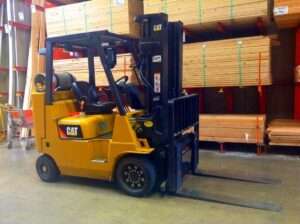
A warehouse forklift is any machine designed to move stock efficiently inside a building on a flat, sealed floor. The most common is the counterbalance forklift — the classic design in which a counterweight at the rear balances the load on the forks, allowing it to drive straight up to a pallet without outriggers. Three-wheel counterbalance models turn in very tight spaces, while four-wheel versions trade some manoeuvrability for extra stability and capacity. Reach trucks and order pickers round out the warehouse family for high-rack and stock-picking operations.
The defining features of a warehouse forklift are:
- Tyres built for smooth floors. Most run on cushion tyres (solid rubber pressed onto a metal band) or solid resilient tyres. Cushion-tyred forklifts have a smaller turning radius, letting them navigate narrow warehouse aisles with ease. They’re also cheaper to maintain and replace, and durable when used correctly. Non-marking tyres are a popular option where clean floors matter, such as food or pharmaceutical sites.
- Clean, quiet power. Electric (battery) forklifts are the go-to choice indoors thanks to zero exhaust emissions and low noise, which help maintain high indoor air quality and suit enclosed spaces. LPG is the common alternative where you want a bit more indoor-outdoor flexibility.
- A compact footprint. Lower to the ground and tighter-turning, they’re made to work efficiently in confined, well-organised spaces.
The trade-off with cushion-tyre forklifts is that, with little ground clearance, they get hung up easily outdoors and aren’t recommended for use on dirt or grass. Take one off smooth concrete and its strengths disappear fast.
What Is A Rough Terrain Forklift?
A rough-terrain forklift is built to do the opposite job — handle heavy loads outdoors on ground that would stop a warehouse machine cold. Think of them as a powerful mix of forklift and tractor, with immense strength and features designed for harsh environments. You’ll see them on construction sites, in lumber and brick yards, on farms, and around scrapyards.
Their defining features are:
- Big pneumatic tyres. Pneumatic tyres are larger, have deeper tread patterns, and are designed to handle rough or uneven terrain; being air-filled, they absorb shock far better than cushion tyres, improving ride comfort and stability. Their deep treads and higher ground clearance deliver strong grip, excellent traction and stability when working with heavier loads on uneven surfaces. Solid pneumatic (airless) versions are common on debris-heavy sites because they can’t be punctured.
- High ground clearance and often 4WD. Rough-terrain machines have extreme ground clearance and four-wheel-drive capability that let them cross packed dirt, gravel, and rougher terrain.
- Diesel power and a tough build. Higher horsepower and a heavy-duty frame suit demanding outdoor work and bigger loads.
The trade-off here is that they’re larger, thirstier, produce exhaust, and their size and tyres make them unsuitable for tight, clean indoor spaces.
Head To Head: The Key Differences
| Warehouse forklift | Rough terrain forklift | |
|---|---|---|
| Best environment | Indoors, smooth sealed floors | Outdoors, uneven unsealed ground |
| Typical tyres | Cushion / solid, often non-marking | Large pneumatic (air or solid) |
| Ground clearance | Low | High |
| Drive | 2WD | Often 4WD |
| Power | Electric or LPG | Usually diesel |
| Manoeuvrability | Excellent in tight aisles | Built for terrain, not tight spaces |
| Emissions/noise | Low (electric) | Higher |
| Floor impact | Minimal on concrete | Will mark indoor floors |
It Often Comes Down To The Tyres
If you remember one thing, make it this: forklifts are largely categorised by tyre type, and the tyre is the critical connection between the machine and the ground. Cushion tyres are smooth solid rubber, easier and cheaper to maintain, and best on flat indoor surfaces. Pneumatic tyres suit outdoor, rough, uneven or gravel surfaces and offer better cushioning and shock absorption, but cost more and need more maintenance.
Matching the tyre to the environment isn’t just about comfort — choosing the wrong type, such as pneumatic on indoor concrete or cushion outdoors, accelerates wear and raises long-term costs. One practical note: most forklift frames only accept a specific tyre type, so the machine and its environment need to be matched from the outset rather than “fixed” with a tyre swap later.
How To Choose The Right Forklift For Your Site
Run through these questions before you buy or hire:
- What surface will it run on? Smooth sealed concrete points to a warehouse machine; gravel, dirt, grass or broken ground points to rough terrain.
- Indoors, outdoors, or both? Be honest about the split. A machine that’s “mostly indoors with the occasional yard trip” has a different answer than a 50/50 operation.
- How heavy and how high are your loads? Capacity and lift height narrow the field quickly — always match the machine to your heaviest, highest task.
- How tight are your aisles and turning spaces? Confined indoor layouts reward a compact three-wheel counterbalance; open yards don’t need that.
- What are your ventilation and emissions requirements? Enclosed or air-quality-sensitive spaces favour electric. Open outdoor work removes that constraint.
- Do you need it long term, or for one job? Short, occasional outdoor work is often better hired than bought.
When You Need The Best Of Both
Plenty of businesses don’t fit neatly into one box. If you’re handling stock indoors most of the time but occasionally need to work in the yard, an LPG counterbalance gives you genuine indoor-outdoor flexibility on suitable surfaces. And if the outdoor work is seasonal or project-based, hiring a rough terrain forklift for those stretches is usually smarter than buying a second machine that sits idle for months — you get the right tool for the job without the capital outlay or ongoing maintenance.
This is exactly the kind of decision worth talking through with someone who works across the full range, rather than guessing and living with it for the next decade.
Get The Right Machine The First Time
The wrong forklift costs you in wear, downtime and safety; the right one just gets the job done. Freedom Forklifts supplies both ends of the spectrum — compact, warehouse-ready electric and LPG machines, and tough diesel rough terrain units — available to hire or buy new or used, and backed by in-house servicing.
Not sure which way to go? Talk to our team about your site, surfaces, and loads, and we’ll match you with the right machine. Our business is keeping your business in business.