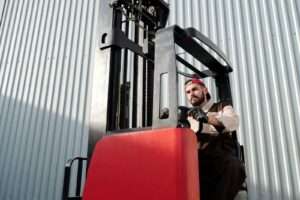
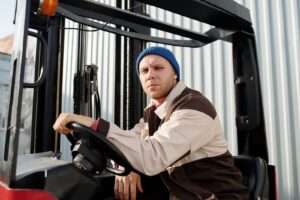
Picking a forklift often comes down to tonnage and fuel type, yet the mast on the front is what actually dictates where the machine can drive, how high it can stack, and how much weight it can safely hold at height.
We created this guide to give operations and warehouse managers an easy-to-understand guide to forklift mast types, critical height measurements, real Australian load-chart de-rating, and how to spec the right mast whether you are hiring or buying.
What Is a Forklift Mast and How Does It Work?
The mast is the vertical rail system at the front of the forklift that raises, lowers, and stabilises loads during operation. It works as an integrated hydraulic and mechanical assembly to control every movement safely and smoothly.
When the operator engages the lift lever, hydraulic fluid is pumped into the hydraulic lift cylinders (which include outer rams and a central cylinder on full-free-lift models). As the cylinders extend, heavy-duty leaf chains operating over pulleys pull the carriage and load backrest upwards along nested steel mast rails and channels at double the ram extension speed. To tilt the load for safe transport or placement, dual tilt cylinders adjust the angle of the entire mast structure relative to the chassis.
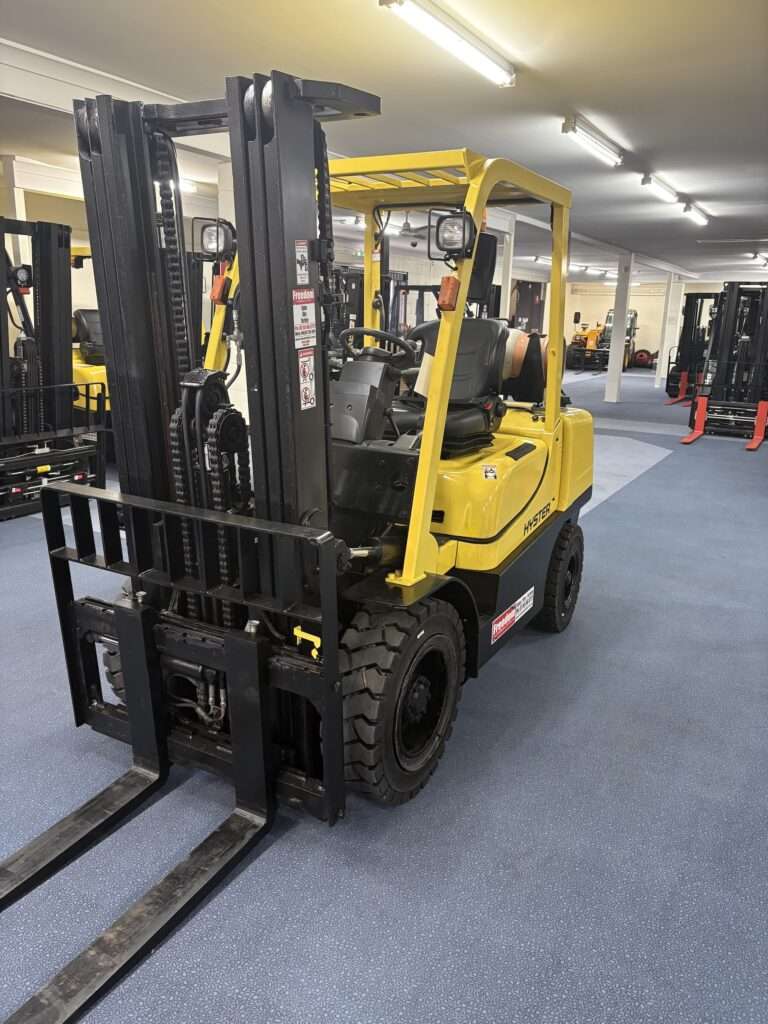
Hyster H3.5XT | 3.5 Tonne LPG Forklift – 3-Stage Mast – at our Nerang location
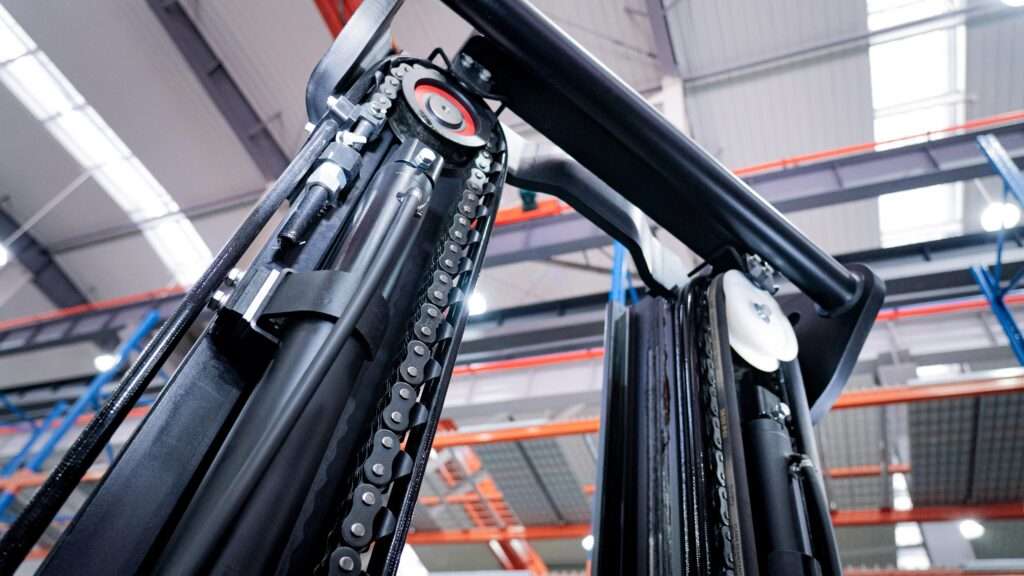
EP Equipment – Mast Free-Lift Chains
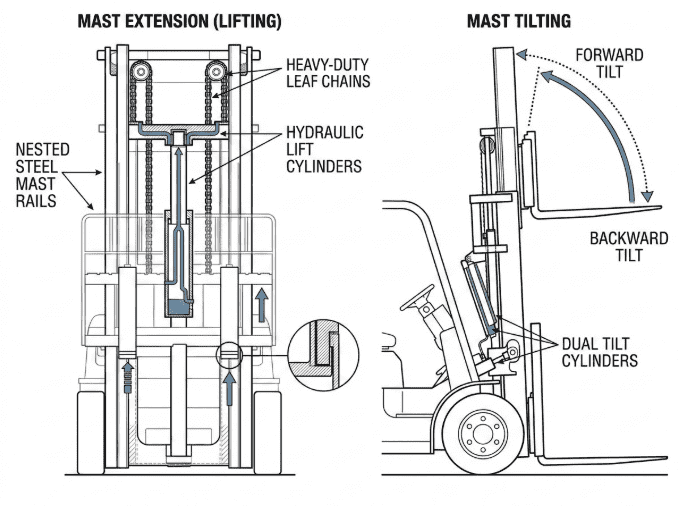
AI-generated diagram – Forklift mast extension and tilting
The Main Types of Forklift Masts
Simplex (Single-Stage) Mast
Simplex masts feature a single outer rail, allowing the carriage to rise along a fixed frame. They provide maximum forward visibility, fewer moving parts, and lower costs. The trade-off is a restricted lift height, typically between 2.7 and 3.3 meters, with zero free lift.
Duplex (Two-Stage) Mast
These masts pair a stationary outer channel with a single inner sliding channel. Standard Duplex models offer limited free lift because the inner rail starts rising immediately as you lift. In contrast, Full Free Lift Duplex models use a central cylinder to raise the carriage to the top of the outer frame before the mast itself extends, making them ideal for areas with restricted overhead room.
Triplex (Three-Stage) Mast
With three nested rail sections and a central free-lift cylinder, the Triplex is the go-to choice for Australian warehouses. It maintains a low collapsed height to easily clear standard doorways while extending up to 4.5 to 6.0 metres or more for high-level racking. The only trade-off is a slightly narrower view through the central rails.
Quad (Four-Stage) Mast
Quad masts utilise four nested rail sections to deliver maximum lift height on a standard counterbalance chassis. However, the extra structure adds weight to the front end, which reduces lifting capacity faster at height and adds mechanical complexity. For extremely tall racking, choosing a dedicated reach truck or high reach forklift is often the better option.
| Mast Type | Stages | Free Lift | Forward Visibility | Best Application |
| Simplex | 1 | Zero | Maximum | Basic outdoor yard work |
| Duplex | 2 | Limited/Full (on FV) | High | Loading docks and low clearances |
| Triplex | 3 | Full | Moderate | Indoor warehousing and high racking |
| Quad | 4 | Full | Reduced | High-bay stacking up to 7.5 m+ |
Free Lift and Container Masts Explained
Free lift determines exactly how high you can raise the tynes before the inner mast rails start extending above the outer mast frame.
When loading shipping containers, standard doorway clearance sits at roughly 2,280 mm, while High Cube doors offer around 2,585 mm. Without full free lift, attempting to double-stack a pallet inside a container forces the inner mast rail straight up into the ceiling.
A dedicated container mast solves this issue by combining a low collapsed height (under 2,150 mm) with full free lift and an integrated side-shifter, allowing operators to manoeuvre safely within tight container spaces.
The Three Forklift Mast Heights That Matter
When selecting a mast, understanding key height specifications is essential for safe operation. Here are the three main measurements you need to evaluate for your site:
1. Overall Lowered Height (OALH/Collapsed Height)
This is the distance from the floor to the top of the mast when fully lowered, which you must measure against your roller doors, awnings, and container openings.
2. Free Lift Height
This represents the maximum fork height you can reach before the overall height of the mast increases, making it crucial for working under mezzanines, coolroom ceilings, and inside enclosed trucks.
3. Maximum Fork Height (MFH)
This measures the distance from the floor to the top face of the tynes at full extension, and as a general rule, you should add a 150 to 200 mm margin above your top racking beam so you can lift the pallet clear without scraping.
How Mast Height Affects Lift Capacity
As you lift a load higher, leverage changes and the truck becomes less stable, which naturally reduces how much weight you can safely carry.
In Australia, forklifts rated over one tonne typically use a standard 600 mm load centre to accommodate 1,200 mm by 1,200 mm hardwood pallets such as CHEP and Loscam. However, some imported models use a 500 mm load centre, which significantly alters safe lifting limits.
Whenever you combine a forklift with an attachment, its rated capacity is reduced because the attachment adds weight and extends the load centre beyond the standard 600 mm line. Because an attachment changes the machine’s stability and operating characteristics, you must always check the forklift’s information plate to confirm the actual capacity of the specific forklift and attachment when they are used together.
The example below illustrates how a standard 2.5-tonne counterbalance forklift (rated at 2,500 kg at a 600 mm load centre) loses capacity at height, and how adding an attachment reduces that capacity even further:
| Lift Height | Rated Capacity (Standard Forks) | Capacity with Side Shifter Fitted |
| 3,000 mm | 2,500 kg | 2,350 kg |
| 4,500 mm | 2,300 kg | 2,150 kg |
| 5,500 mm | 1,950 kg | 1,800 kg |
| 6,000 mm | 1,700 kg | 1,550 kg |
Under AS 2359.1 and Safe Work Australia guidelines, you must confirm the rated capacity on the data plate, not the model number, every single time. To understand this further, read our guides on forklift data plates explained and how to calculate forklift load capacity.
If you are ever unsure about ratings or compliance, always consult the manufacturer or refer directly to safety guides from SafeWork NSW, WorkSafe Victoria, or WorkSafe Queensland.
How to Choose the Right Mast for Your Site
Run through this practical 5-point checklist before making a final decision:
1. Lowest Overhead Pinch Point
Measure your lowest roller door, overhead pipe, or container doorway rather than relying on your main warehouse ceiling height. Taking accurate measurements across all potential travel paths ensures your equipment moves safely without unexpected obstruction.
2. Highest Racking Beam + Clearance
Add a 150 to 200 mm lift margin above your highest racking shelf. This additional space guarantees that operators can lift and manoeuvre pallets cleanly without scraping the structure.
3. Heaviest Load at Maximum Height
Check the residual capacity at your top lift height rather than relying on the badge tonnage printed on the counterweight. Safe operation requires verifying how much weight the truck can safely handle when fully extended.
4. Attachments & Hydraulic Functions
Account for side-shift weight and confirm whether you need third or fourth-valve hydraulic hosing routed over the mast to power attachments. Factoring in additional attachments upfront prevents unexpected reductions in lifting capacity and operational delays.
5. Indoor vs Outdoor Conditions
Smooth warehouse floors tolerate tall 3-stage or 4-stage masts easily. Conversely, uneven yards or construction sites require extra care with high masts and forward tilt to ensure stability during transport.
Common Forklift Mast Problems and Pre-Start Checks
Masts work incredibly hard, and parts inevitably wear out. In real operations, you will encounter stretched lift chains causing jerky movements, worn mast rollers creating lateral slop, weeping hydraulic cylinder seals causing mast “drift,” and damaged hoses snagging on pulleys.
To prevent incidents, operators must perform disciplined daily pre-operational checks. You need to check chain tension, inspect rams and hoses for oil leaks, verify carriage lock pins, and run a full unloaded raise, lower, and tilt check before lifting stock. If your mast is drifting or binding, our team provides expert forklift servicing and repairs.
Choosing a Mast When You Hire, Lease or Buy
Whether you are looking to hire, lease, or purchase outright, selecting the right mast configuration will ensure your forklift suits your specific operational environment.
Short-Term Hire
Do not settle for whatever mast is sitting on the yard. Tell your hire provider your lowest doorway and highest rack so you do not end up with a standard 2-stage mast that will not enter a container. View our forklift hire options here.
Long-Term Leasing
If your warehouse layout might expand vertically in 12 to 24 months, specify a 3-stage container mast upfront so you are not locked into a low-reach machine. Factoring in future racking growth when structuring your lease helps you avoid costly early contract upgrades or operational bottlenecks later on.
Buying New or Used
On used machines, inspect mast roller wear and verify that the data plate exactly matches the fitted mast, as mast swaps are incredibly common on secondhand trucks. You can view our range of new forklifts or used forklifts online.
Need Help Selecting the Right Forklift Mast?
Choosing the correct mast configuration requires balancing overhead clearance, required lift height, and de-rated load capacities. Whether you need a low-profile container mast, a high-reach Triplex, or guidance on residual capacity at full extension, our team can help you find the exact specification for your operational layout.
Explore our forklift hire options, browse our range of new forklifts and used forklifts, or contact our team today. You can reach our Nerang workshop on 07 5596 5777 or our Yatala team on 07 3059 5044 for tailored technical advice.