Imagine walking through your busy Brisbane transport hub or Yatala logistics yard, evaluating your capital allocation. On paper, a brand-new internal combustion forklift looks like an absolute bargain. The sticker price is highly competitive, and the dealer is offering immediate delivery.
Is it actually worth the spend?
Look beyond the sticker price. A forklift’s real cost is its five-year running total. This includes fuel, servicing, compliance, and the tax credits you may or may not be claiming. Choose wisely and you will save tens of thousands and keep your overheads down.
Forget the glossy brochures and start comparing the numbers. Here is a five-year, no-nonsense comparison of electric, LPG and diesel running costs, built on current Australian fuel and electricity pricing. We will show you the real numbers on energy, servicing and on-site demands, so you can make a call that actually protects your bottom line.
What Does It Cost To Buy In?
When expanding your fleet, the initial acquisition cost is your first major hurdle. While pricing fluctuates based on brand, mast configuration and local freight, here are the realistic market brackets for a new three-tonne counterbalance machine in Australia. All figures exclude GST.
- LPG counterbalance forklift: $34,000 to $55,000
- Diesel counterbalance forklift: $36,000 to $56,000
- Electric counterbalance forklift: $38,000 to $70,000, with the spread driven largely by lead-acid versus lithium-ion
At first glance, an LPG or diesel unit saves you upfront capital compared to a like-for-like electric model. However, the machine purchase is only part of the buy-in equation. You also need to account for the physical on-site infrastructure each power source requires.
LPG Infrastructure
This is the simplest setup. You will need a secure, well-ventilated outdoor gas bottle storage cage that complies with AS/NZS 1596 for LPG storage and handling. Cylinder suppliers typically lease these cages to your site for a minimal monthly fee, making the initial setup cost close to negligible.
Diesel Infrastructure
Similar to gas, diesel forklifts require safe storage of bulk fuel if you run a larger fleet. That means installing an on-site diesel storage tank with a pump system, or organising a regular mobile refuelling service, which carries minor compliance and environmental management costs.
Electric Infrastructure
Charging a three-tonne electric forklift typically requires a dedicated bay with a commercial 415V three-phase power outlet. If your warehouse needs a three-phase switchboard upgrade or new supply lines, expect installation costs between $3,000 and $10,000 or more, depending on concrete trenching. Modern lithium-ion setups need little more than a protected wall space, while traditional lead-acid banks also require mandated ventilation and acid-spill safety stations.
One upside worth modelling: if your site already has rooftop solar, daytime opportunity charging draws power at your effective generation cost rather than your grid rate. On a well-sized commercial array, this can cut the energy line in the table below by half or more.
What Does The Energy Actually Cost?
This is where the financial balance shifts decisively. Internal combustion machines are cheaper to buy, but their hourly fuel consumption quickly overtakes that saving. Here is the maths for each machine style running 1,500 hours per year, which represents a typical single-shift operation.
| Powertrain | Realistic hourly cost | Annual cost (1,500 hrs) | 5-year energy total | Key assumption |
|---|---|---|---|---|
| Electric | $1.20 to $3.60 | $1,800 to $5,400 | $9,000 to $27,000 | 5 to 9 kWh draw plus 10 to 15% charger losses, at $0.22 to $0.35/kWh commercial rate |
| LPG | $6.00 to $10.00 | $9,000 to $15,000 | $45,000 to $75,000 | 18kg cylinder swap at $60 to $80, lasting 8 to 10 operating hours |
| Diesel | $6.15 to $9.30 | $9,200 to $14,000 | $46,000 to $70,000 | 2.8 to 3.8 L/hr burn at $2.20 to $2.45/L bulk delivered, before fuel tax credits |
Two assumptions are worth stating plainly. Electric consumption varies widely with load and duty cycle, and Linde Material Handling Australia puts a 1.5 to 3.5 tonne electric forklift at roughly 4 to 12 kWh per hour, so treat the band above as a single-shift midpoint rather than a guarantee. Diesel pricing moves constantly, and the figures here reflect bulk delivered rates rather than retail pump prices. You can track the current position through the Australian Institute of Petroleum, which publishes weekly retail and terminal gate diesel prices.
Taken at face value, a single machine on a standard single shift costs roughly $8,000 to $8,400 more per year to run on gas or diesel than on electricity. Over five years, that is a fuel gap of about $40,000 to $42,000. Before you bank that number, read the next section, because it changes the diesel column materially.
The Fuel Tax Credit Most Operators Forget
A forklift working on private property is off-road business use. That makes the diesel it burns eligible for the full fuel tax credit, which is worth 53.7 cents per litre for fuel acquired from 3 August 2026.
On the consumption figures above, that credit is worth roughly $2,250 to $3,050 per machine per year, or $11,000 to $15,000 across a five-year cycle. It is claimed through your BAS, and the rate is set by the date you acquired the fuel, not the date you lodge.
LPG used off-road also attracts a fuel tax credit, though at a different rate and with its own record-keeping requirements. Rates change, and there have been several adjustments through 2026, so confirm your current position using the ATO’s fuel tax credit rates for business before you build it into a budget.
The tables in this article show fuel costs gross of credits, because that is what leaves your bank account at the point of purchase. If you are claiming correctly, reduce the diesel line accordingly. If you are not claiming, that is money sitting on the table.
Servicing And Maintenance
There is a fundamental mechanical difference between combustion and electric drivetrains. LPG and diesel forklifts use internal combustion engines with hundreds of moving parts, high operating temperatures and constant vibration. Electric models rely on AC electric motors with very few moving components.
That difference flows straight through to your ongoing maintenance costs and service schedules.
LPG and Diesel Servicing
Internal combustion forklifts require preventative servicing every 250 to 500 operating hours. Over a standard five-year cycle of 7,500 operating hours, maintenance typically totals $15,000 to $20,000 for LPG and $17,000 to $26,000 for diesel, including scheduled fluid servicing, filters, ignition components, and two sets of drive tyres at $1,200 to $2,500 per set.
Electric Servicing
Electric forklifts cut the maintenance burden meaningfully. With far fewer wear items, service intervals extend to every 500 to 1,000 hours. Expect a five-year spend of $10,000 to $16,000 depending on tyre replacement cycles, which represents a saving of roughly 25 to 40 per cent against a comparable combustion machine.
Battery choice then drives the rest of the picture.
- Lead-acid: A lower purchase price, but it demands weekly top-ups with demineralised water and disciplined equalisation charging. Neglecting that maintenance and premature cell failure brings forward a replacement of $8,000 to $12,000 around year five or six.
- Lithium-ion: An upfront premium of $8,000 to $15,000 buys a low-touch operating model. No fluid maintenance, support for fast opportunity charging during scheduled breaks, and an eight- to ten-year operational lifespan that pushes replacement entirely outside the five-year window.
Downtime, Charging And Refuelling
Your fleet only makes money when it is moving pallets. The logistics of refuelling have a real impact on daily productivity.
Lpg Refuelling
Refuelling is fast and straightforward. When a cylinder is empty, the operator closes the valve, disconnects the coupling, swaps in a full 18kg industrial cylinder and restarts the machine. The exchange takes roughly two to three minutes, allowing near-continuous multi-shift operation.
Diesel Refuelling
Like gas, diesel refuelling takes under five minutes at a dedicated on-site bowser or fuel pod, making it well suited to continuous, high-throughput site work.
Electric Charging
Charging is the main operational trade-off of electric power.
- Single-shift operations: For standard eight-hour daily shifts, charging is simple. The operator connects the machine at the end of the shift, and it charges overnight, typically six to eight hours, ready for the next day.
- Multi-shift operations (16+ hours): On continuous double or triple shifts, standard lead-acid batteries struggle without extra infrastructure. Maintaining uptime means a second battery pack and specialised extraction equipment to swap the roughly one-tonne battery between shifts, adding $10,000 to $20,000 upfront. That is why round-the-clock sites usually land on opportunity-charged lithium-ion or LPG instead.
Site And Application Constraints
You cannot choose a forklift purely on a spreadsheet. Your physical site conditions have to dictate the machine class.
Indoor Warehousing And Food Handling
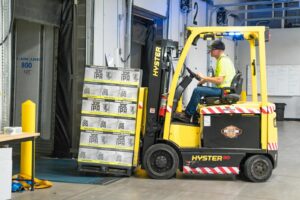
For enclosed facilities, cold storage and food manufacturing environments, electric is the industry benchmark. Internal combustion units release carbon monoxide, nitrogen oxides and particulates that contaminate enclosed air and stock.
Under Australian WHS regulations, operating an LPG or diesel forklift indoors requires a documented risk assessment and adequate mechanical ventilation to keep carbon monoxide exposure below the workplace exposure standard. Safe Work Australia’s workplace exposure limits for airborne contaminants set carbon monoxide at 20 ppm as an eight-hour time-weighted average. Adoption of the revised limits has been staged across jurisdictions, and some state regulator pages still reference the previous 30 ppm figure, so confirm the standard in force in your state before you build a monitoring plan around it.
If you run LPG, remember the gas fuel system itself must be inspected and certified annually under AS 4983-2010. A current certificate is required for the machine to legally operate, and it typically costs $200 to $450 per unit per year.
Unpaved Yards And Wet Weather
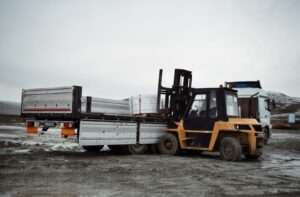
If your site features unpaved gravel hardstand, rough ground, steep ramps, or regular work in heavy rain, diesel and LPG counterbalance models remain the practical choice. Higher ground clearance, robust drive axles and deep-tread pneumatic tyres handle loose or uneven surfaces easily. Sealed, outdoor-rated electric counterbalance models are readily available, but standard indoor electric units have lower chassis clearance and basic weatherproofing, so gravel and deep puddles can cause severe mechanical strain or expensive controller damage.
Five Years, Side-By-Side
Here is the full five-year total cost of ownership model. It assumes a new three-tonne counterbalance forklift running 1,500 hours per year, or 7,500 hours in total, under single-shift indoor and outdoor conditions.
| Component | Electric | LPG | Diesel | Notes |
|---|---|---|---|---|
| Initial purchase (mid-range) | $42,000 to $58,000 | $38,000 to $55,000 | $40,000 to $56,000 | Includes side-shift and 3-stage container mast, ex GST |
| Fuel/energy cost | $9,000 to $27,000 | $45,000 to $75,000 | $46,000 to $70,000 | Based on 7,500 hrs, gross of fuel tax credits |
| Maintenance and tyres | $10,000 to $16,000 | $15,000 to $20,000 | $17,000 to $26,000 | Scheduled PM services, fluid changes, 2 sets of drive tyres |
| Battery replacement | $0 to $12,000 | N/A | N/A | $0 for lithium-ion; $8,000 to $12,000 if replacing neglected lead-acid |
| Compliance and inspections | $1,500 to $2,500 | $2,000 to $3,500 | $1,500 to $2,500 | Annual safety inspections, AS 4983-2010 gas certification, WHS documentation |
| 5-year total cost of ownership | $62,500 to $115,500 | $100,000 to $153,500 | $104,500 to $154,500 | Gross of fuel tax credits |
| Diesel adjusted for fuel tax credits | N/A | See note | $93,500 to $139,500 | Diesel total less 53.7c/L off-road credit on 7,500 hrs of use |
Figures are commercial estimates based on Australian market rates as at September 2026 and single-shift operations of 1,500 hours per year. Fuel, electricity and fuel tax credit rates change frequently, so treat these as a modelling framework rather than a quote. The upper electric figure assumes a lead-acid battery replacement at year five or six, which is avoided entirely with lithium-ion. LPG fuel tax credits apply but are not modelled here, as the rate differs from diesel and depends on your supply arrangement.
Which One Suits Your Operation?
Your site conditions are the final piece of the puzzle. Choosing the right forklift is not just about the spreadsheet. It is about matching the machine to your floor surface, operating hours and local environment. Use the comparison below to identify the configuration that actually aligns with your day-to-day demands.
- High-density warehouse: Single shifts in an enclosed space with flat concrete aisles and noise sensitivity. The electric counterbalance wins on cost and compliance.
- Continuous multi-shift yard: Sixteen-hour-plus schedules, outdoor shipping containers, or steep gradients where three-phase charging is not an option. Stick with the LPG counterbalance.
- Heavy industrial depot: Timber yards, steel manufacturing, or rough unpaved sites that run in all weather. The diesel counterbalance provides the rugged reliability you need, and the fuel tax credit narrows the running cost gap considerably.
Talk To The Freedom Forklifts Team
Choosing between electric, LPG, and diesel is not about finding a single best machine. It is about matching the equipment engineering to your physical site constraints and financial goals. At Freedom Forklifts, we do not push you toward a specific fuel type to hit a sales quota. Our focus is honest, numbers-backed advice that protects your bottom line.
We can help you analyse your operating hours, inspect your concrete surfaces, evaluate your charging infrastructure and calculate your true forklift total cost of ownership. Whether you need to hire a forklift for a seasonal peak, explore a flexible hire-to-own trial, or browse our range of new forklifts and used forklifts, our local team is here to help.
Our fully equipped workshops in Nerang and Yatala service Brisbane, the Gold Coast, Logan and Northern NSW. To keep your fleet safe and compliant, we also provide scheduled forklift servicing and repairs on-site or in our workshop. Get in touch with our expert team today or call our Nerang head office directly on 07 5596 5777 to discuss a customised cost model for your business.